The Co-Packer’s Guide to Beverage Haze Complaints: Where Formulation Ends and Plant Control Begins
Haze complaints rarely arrive as a clean technical problem. They arrive as a customer email with photos, a retained sample on a conference room table, a hold tag in finished goods, and a production team trying to keep the next SKU on schedule.
For a contract beverage co-packer, haze is not just a formulation issue. It is a control issue across receiving, batching, enzyme contact, filtration, thermal treatment, packaging, and storage. The formula may be sound on paper, but the plant decides whether the drink moves through tanks cleanly, filters predictably, and reaches the customer with the expected appearance.
Switchyard Catalytics works as an enzyme supplier for beverage co-packers that need practical haze-control support without turning every launch into a lab project. The goal is simple: reduce avoidable rework, protect line time, and build a trial path your QA, operations, and customer teams can understand.
Request a quote for a beverage enzyme recommendation built around your substrate, process window, and packaging format.
Why haze escalates fast in a co-packing plant
In a single-brand facility, the process can be tuned around a narrow product set. In a co-packing plant, the line may move from tea to juice blend to functional beverage to flavored water in the same production week. That creates multiple haze-risk points:
- Variable fruit, botanical, grain, or sweetener inputs
- Concentrates with different pectin, starch, protein, or polyphenol behavior
- Short lead times between formulation approval and first production
- Limited tank availability during contact or hold steps
- Filter loading that changes from lot to lot
- Customer expectations that may not match plant reality
- Changeovers where residue control matters to the next SKU
A haze complaint can look like a quality event, but the root cause often sits between formulation chemistry and plant execution.
Start with the complaint type, not the assumption
Before changing the formula or blaming filtration, classify what the customer is seeing. The wrong assumption can send the team into weeks of unnecessary adjustments.
Immediate haze
If the beverage is hazy before or shortly after packaging, look at raw material variation, incomplete solubilization, pectin or starch load, protein interaction, high suspended solids, or insufficient enzyme contact. Immediate haze often points to a batching and clarification issue.
Delayed haze
If the beverage clears at release but develops haze during storage, examine thermal history, pH, metal ions, oxygen exposure, protein-polyphenol interaction, and residual colloids that were not fully addressed upstream. Delayed haze is where documentation matters: retained samples, production times, tank temperatures, filtration pressure trend, and lot codes all help narrow the field.
Ringing, sediment, or flocculation
Sediment and floc are not the same as uniform haze. They may point to destabilized cloud systems, insoluble botanical solids, starch retrogradation, pulp instability, or interaction with minerals and functional ingredients. Enzymes can help in specific cases, but the process map must come first.
Where formulation ends and plant control begins
The formulation defines the risk. The plant determines the expression of that risk.
A beverage formula may include fruit concentrate, tea extract, botanical infusion, fiber, sweetener, acidulant, mineral blend, color, and flavor. Each component can be stable in isolation and still create haze when combined at production scale.
The plant control questions are more direct:
- Was the concentrate fully dispersed before acid addition?
- Was the tank mixed long enough to prevent dead zones?
- Did ingredient order change between pilot and production?
- Was the enzyme added at a point where it could actually contact the target substrate?
- Did temperature drift outside the intended process window?
- Was contact time shortened to recover schedule?
- Did filtration pressure rise faster than expected?
- Did the same product behave differently after a raw material lot change?
- Was the line pushed through a changeover before the prior SKU residue was fully cleared?
These questions are not academic. They decide whether the beverage runs clean or turns into a production argument.
Enzymes as a plant-control tool
For beverage co-packers, enzymes are most useful when they solve a defined operational problem. That may include reducing pectin-related viscosity, improving juice clarification, lowering filter load, addressing starch-driven haze, supporting extraction, or helping a botanical or fruit system behave more predictably in the tank.
The value is not simply that an enzyme exists. The value is whether the enzyme can fit your process without creating a new bottleneck.
A practical enzyme recommendation should account for:
- Product type and raw material source
- pH and temperature range during batching
- Available tank time before filtration or thermal treatment
- Mixing behavior and batch size
- Filter type and pressure tolerance
- Packaging format and shelf-life target
- Label, customer, and documentation requirements
- Cleaning and changeover realities
Switchyard Catalytics focuses on the production window, not just the bench result. A successful trial should tell operations what changes, where it changes, and how to repeat it.
Haze-control checkpoints for beverage co-packers
Use these checkpoints before the next customer complaint becomes a full corrective action.
1. Map the ingredient order
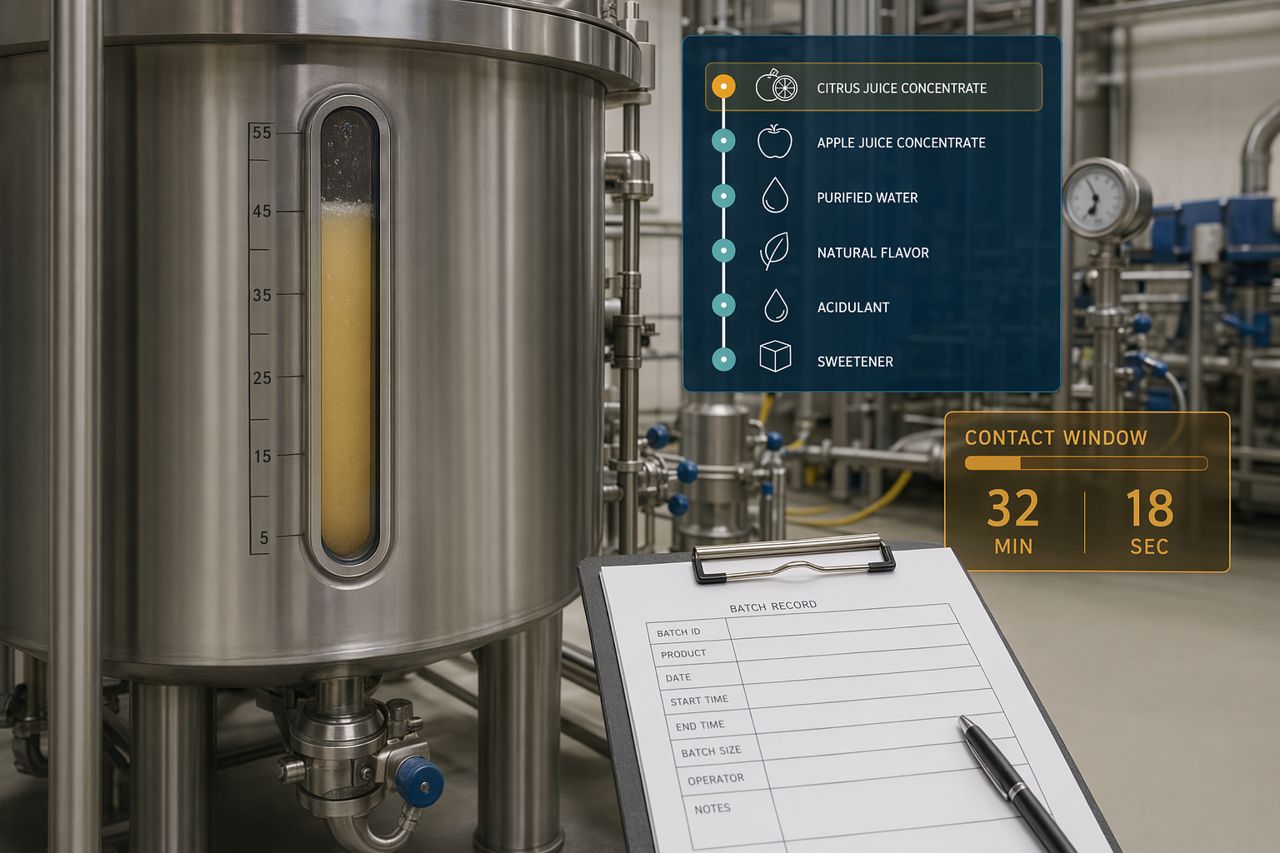
Small changes in addition sequence can change tank behavior. Acid, sweetener, concentrate, botanical extract, and enzyme addition points should be documented in the batch record. If the bench formula used one order and production used another, haze investigation starts there.
2. Capture tank behavior, not just final appearance
Operators often see the first warning signs before the lab does: sluggish circulation, foam change, inconsistent draw, visible strings, dull surface, or solids settling near a manway. Add simple observations to the batch record. They help connect the complaint to the process.
3. Watch filtration pressure trend
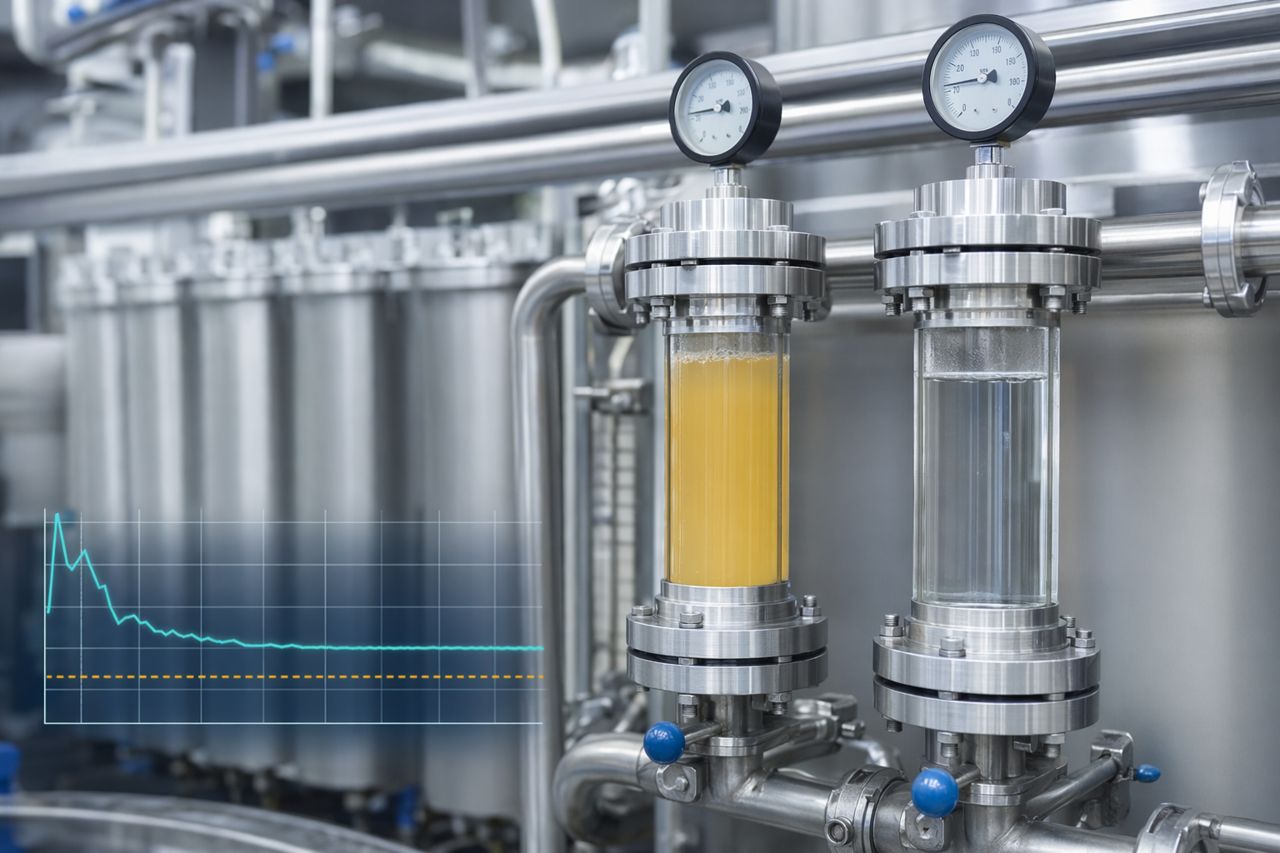
A filter that starts clean but loads rapidly is a signal. The beverage may be carrying pectin, starch, fine pulp, colloidal material, or extract solids that were not controlled upstream. Enzyme treatment can relieve filtration load when the substrate and timing are right.
4. Separate haze from cloud intent
Some beverages are designed to be cloudy. The issue is whether the cloud is uniform, stable, and expected. Enzyme use must respect the desired appearance. In a cloudy juice blend, the target may be reduced viscosity and better processability, not full clarification.
5. Build changeover discipline into the trial
A haze fix that works only in an isolated trial may fail in a real co-packing week. Include the upstream and downstream SKUs in the planning conversation. Residue, CIP effectiveness, allergen controls where applicable, and flavor carryover can all affect how a beverage appears and filters.
6. Preserve retained samples by process point
Do not rely only on finished goods. Retain samples after batching, after enzyme contact, after filtration, after thermal treatment, and after packaging when feasible. A staged sample set helps identify where haze emerges or where it was removed.
What a controlled enzyme trial should look like
A co-packer-friendly enzyme trial should be narrow, documented, and repeatable. It should not disrupt the production schedule or require operators to interpret vague instructions mid-run.
A usable trial plan includes:
- The target problem: haze, viscosity, filter loading, sediment, or delayed instability
- The product family and raw material lot information
- The enzyme addition point
- The intended contact window
- The mixing and temperature expectations
- The filtration or separation step to monitor
- Retained sample points
- Release and hold criteria agreed before the run
- A simple decision tree for scale-up, repeat trial, or stop
The best trials are boring in the right way. Everyone knows what will be measured, what success looks like, and what happens if the batch does not behave as expected.
Documentation protects the plant
When haze becomes a customer issue, documentation is your defense and your improvement path. A strong record shows that the plant controlled the variables it could control and had a rational basis for any process adjustment.
For enzyme-supported haze control, document:
- Product code and customer formula revision
- Raw material lots most likely to affect haze
- Batch size and tank used
- Addition sequence
- Enzyme lot and addition point
- Contact time and temperature window
- Filtration observations and pressure trend
- Visual checks at defined points
- Retained sample IDs
- Deviation notes and operator comments
Good documentation does not slow the plant down when the template is built correctly. It reduces repeated debates.
When to call Switchyard Catalytics
Bring us in when haze, viscosity, or filtration behavior is starting to affect production reliability. The earlier we see the process map, the easier it is to recommend an enzyme path that fits the plant.
We can support:
- Juice and fruit blend clarification challenges
- Pectin-related viscosity reduction
- Starch-related haze in beverage bases
- Botanical and tea extract process issues
- Filtration relief projects
- Trial planning for customer launches
- Documentation language for operations and QA alignment
We are not here to sell a generic additive into a complex line. We are here to help your team identify where an enzyme can create measurable plant value: cleaner tank behavior, more predictable filtration, fewer haze surprises, and better launch discipline across multiple SKUs.
Request a quote
If you are managing haze complaints or preparing a beverage launch with known clarification risk, send us the product type, ingredient base, process window, filtration step, and packaging format.
Request a quote and Switchyard Catalytics will respond with a practical enzyme recommendation for your co-packing environment.